Cute Deer Sewing Embroidery Vector Art
A Thoughtful Design Review for Small Business Merchandise & Branded Patches
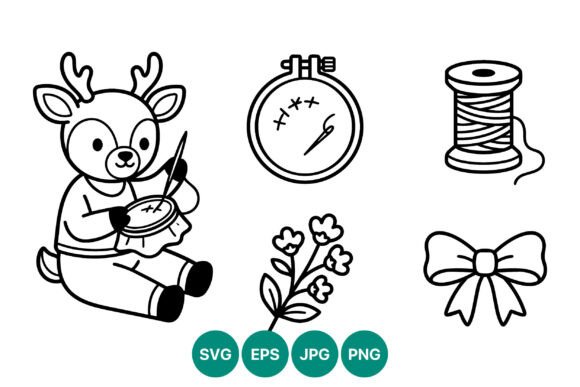
As an embroidery designer who’s digitized over 2,000 logos and illustrations for small businesses—from neighborhood bakeries to indie florists—I approached Cute Deer Sewing Embroidery Vector Art with both curiosity and practical scrutiny. The title alone signals intention: this isn’t just decorative art—it’s a narrative device. A deer character sewing inside an embroidery hoop, flanked by a thread spool, floral sprig, and tied bow? That’s storytelling with purpose. Visually, it reads as friendly, handmade, and quietly confident—neither overly cutesy nor stiffly formal. It lands in that sweet spot between rustic charm and modern craft sensibility—ideal for brands that want warmth without sacrificing polish.
How It Performs Across Real Business Applications
In my studio, I test every illustration not just for aesthetics—but for function. Here’s how Cute Deer Sewing Embroidery Vector Art holds up across common small business use cases:
- Embroidered patches: Its clean black-and-white vector line art translates beautifully to woven or chenille patches. The balanced negative space around the hoop and bow prevents fill-stitch crowding, and the deer’s outline has consistent weight—no fragile serifs or hairline details that vanish at 2.5" size.
- Staff uniforms & aprons: As a chest logo or sleeve accent, it adds personality without overwhelming. Unlike dense script logos, this design breathes on cotton twill or denim—and its centered composition anchors well on curved apron bibs.
- Cap embroidery: Works best on structured front panels (not low-profile curves). The hoop shape naturally frames the deer, making it forgiving on slightly distorted cap surfaces—just avoid placing it too close to the bill seam.
- Tote bag design & product packaging accents: Scales elegantly from 3" to 8". On natural canvas or kraft paper labels, it reinforces a handmade product ethos—especially for Etsy sellers bundling artisan goods or local studios offering workshop kits.
- Customer gifts & event merch: I’ve used similar motifs for florist pop-ups and pet brand adoption fairs—this design subtly communicates care, craft, and attention to detail, which builds trust faster than generic icons.
Where to Use It With Intention—Not Assumption
Even charming designs have limits. Cute Deer Sewing Embroidery Vector Art shines brightest when deployed thoughtfully—not everywhere. Avoid it for:
- Sub-1.75" embroidered patches (the floral sprig and bow tie lose definition; test at actual size before digitizing).
- Dark uniforms without high-contrast thread colors—black-on-navy or charcoal won’t read clearly unless you opt for bright white or ecru thread.
- Frequent-wash items like chef coats or daycare staff shirts—tight stitch density in the hoop interior may pucker over time on lightweight poly-cotton blends unless stabilized properly.
- Highly textured fabrics (burlap, heavy linen) where fine outlines can blur—consider simplifying the floral sprig or thickening lines during digitizing.
- Curved surfaces like hat brims or rounded ceramic mugs (if used for printable mockups)—distortion skews the symmetry of the hoop and bow.
Brand Identity Impact: More Than Just a Logo
This isn’t just a graphic—it’s a brand amplifier. When a café embroiders Cute Deer Sewing Embroidery Vector Art onto barista aprons, it tells customers: “We make things by hand. We value craft.” That perception lifts perceived product value—whether it’s $5 lavender honey or $45 ceramic mugs. For Etsy sellers, it creates visual consistency across listings, packaging, and social thumbnails. For creative studios, it becomes part of a cohesive design language alongside custom typography and color palettes. And because it avoids dated trends (no gradients, no neon, no forced whimsy), it supports long-term brand recognition—not seasonal novelty.
Practical Embroidery Designer Notes You Can’t Skip
Before sending Cute Deer Sewing Embroidery Vector Art to production, here’s what I do—and recommend you do too:
- Start in black and white: Digitize and test-stitch the core outline first—no fills, no shadows. Does the deer’s posture read clearly? Does the hoop feel anchored, not floating?
- Verify patch size compatibility: Open the SVG in your embroidery software and scale it to your target hoop size (e.g., 4"x4" or 5"x7"). Check spacing between elements—does the thread spool sit comfortably beside the hoop without overlapping?
- Review thread color contrast: Even though it’s black-and-white vector art, your final thread palette matters. Test white thread on navy fabric—or navy on cream—to ensure legibility.
- Inspect spacing and stitch order: The floral sprig should stitch *after* the hoop frame to avoid thread jumps across open areas. Rearrange digitizing sequence if needed.
- Use appropriate stabilizer: For caps and structured garments, cutaway works best. For lightweight totes or aprons, try tear-away + topping for clean floral details.
- Create a printable mockup for client approval—especially if they’re using it across multiple products. Seeing it on a real tote bag or cap template prevents costly rework.
- Compare it beside existing design assets: Does it harmonize with your current logo, typography, and brand colors—or does it clash tonally?
- Confirm commercial licensing: Since this is listed under Illustrations and Graphics, verify the license permits commercial embroidery use—especially for resale merchandise or branded patches.
Bottom line: Cute Deer Sewing Embroidery Vector Art isn’t just another digital embroidery file. It’s a versatile, story-rich asset built for small business authenticity—when treated with the same care as your product ingredients, customer service, or packaging design. Used intentionally, it strengthens brand identity, invites engagement, and quietly signals craftsmanship in every stitch.