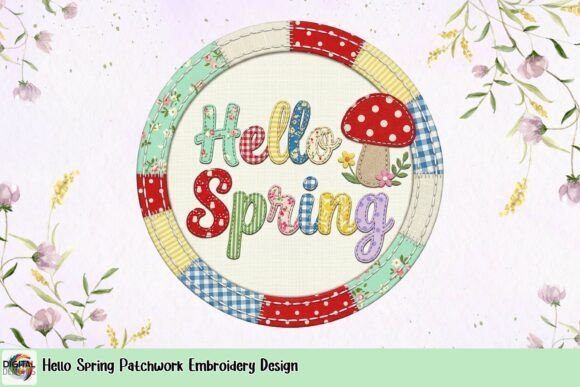
Hello Spring Patchwork Embroidery Design
First Impression: Joyful, Approachable, and Instantly Seasonal
As an embroidery designer who’s curated over 200 craft fair booths—and sold thousands of handmade items—I instantly recognize what makes Hello Spring Patchwork Embroidery Design stand out: it’s cheerful without being cutesy, detailed without feeling fussy, and authentically handmade in spirit. The phrase “Hello Spring” stitched in colorful, fabric-like letters suggests warmth and renewal, while the vibrant patchwork border adds texture, rhythm, and a tactile sense of craft. It reads as friendly farmhouse meets modern handmade—neither overly rustic nor sterile-minimal. That balance is gold at craft fairs, where shoppers scan dozens of tables in under 90 seconds.
Where This Design Shines on Craft Fair Products
This machine embroidery design isn’t just versatile—it’s *strategic*. On a natural canvas tote bag, the patchwork border frames the phrase beautifully, giving structure to an otherwise simple silhouette. As an apron embroidery, it lands perfectly above the pocket—large enough to read from three feet away, yet soft enough to feel personal. For tea towel embroidery, the design scales well when centered on the lower third; the fabric-like lettering echoes linen and cotton textures, enhancing perceived quality.
It works exceptionally well as an embroidered patch—ideal for pinning onto denim jackets or stitching onto market bags. On small pouches and pillow covers, it holds clarity even at 3.5" wide, thanks to generous spacing and bold letterforms. As a cap embroidery? Use it on the front panel only—not curved sides—and keep the height under 2.25" to maintain legibility. Avoid placing it on dark fabric unless you’ve tested thread contrast thoroughly: pastel threads may mute, while high-contrast combos (kelly green + navy, coral + charcoal) pop with intention.
What Makes It Sell—And What Requires Caution
Selling strengths: Customers gravitate toward seasonal joy they can *feel*—not just see. “Hello Spring” delivers emotional resonance, especially in March and April. Its patchwork motif subtly signals craftsmanship, elevating perceived value of any finished product. At a booth, it draws eyes faster than monogrammed or abstract graphics because it combines readable language + visual pattern + color energy. As a small shop product, it supports brand consistency across categories: same design on a tea towel, patch, and pillow cover creates cohesive storytelling.
Careful-use notes: While the description mentions “colorful, fabric-like letters,” tight corners in the patchwork border may increase stitch density—especially where seams intersect. That means heavier stabilizer is non-negotiable on textured towels or thick denim. Tiny floral motifs (if included in the border) could blur on curved cap surfaces or low-thread-count fabrics. And crucially: this design is not optimized for sub-2" scaling. Small lettering loses definition fast—so avoid using it as a subtle accent on wristlets or keychains unless you’ve verified clarity on your actual embroidery machine.
Photography & Online Performance
This embroidery file photographs brilliantly—especially with natural light and neutral backdrops. The patchwork border adds dimension that translates well in Etsy listings and printable mockups. Unlike flat vector graphics, its layered, textile-inspired look conveys authenticity to digital buyers scanning for “handmade” cues. For Etsy sellers, pairing it with lifestyle shots (e.g., a sunlit kitchen with embroidered tea towels and a potted hyacinth) boosts conversion. Just remember: always shoot real stitched samples—not just screen mockups—to prove quality and thread richness.
Batch Production & Booth Readiness
From a production standpoint, Hello Spring Patchwork Embroidery Design is highly repeatable. Its balanced proportions, clear focal point, and moderate stitch count (assuming standard density) support consistent hooping and trimming across 50+ tote bags or aprons. That predictability matters when you’re stitching 3 a.m. before a Saturday market. But don’t skip the test run: hoop scrap fabric matching your final product (linen blend? canvas? terry cloth?), run one full design, and inspect spacing, thread tension, and edge finish. Compare how it reads on light vs. medium fabric tones—you’ll likely need two thread palettes.
Designer Notes You Can’t Skip
Before cutting into your best fabric or uploading to your Etsy shop:
- Test the embroidery file on scrap fabric *identical* to your intended product—thread behavior changes drastically between cotton poplin and terry loop.
- Check thread contrast rigorously. Light yellow on ivory? Might vanish. Deep teal on navy? Could read as black. Print a swatch chart first.
- Review spacing between letters and border elements. Tight kerning looks elegant digitally but may cause nesting or skipped stitches on slower machines.
- Confirm hoop size compatibility. If the full design exceeds 5x7", verify your machine handles larger hoops—or plan for re-hooping (a time-suck at craft fairs).
- Inspect stitch density in the patchwork sections. Dense fills require tear-away + cut-away stabilizer combo on unstable weaves.
- Create at least one real-world mockup: stitch it onto your chosen tote bag, photograph it in situ, and hold it up beside your other top sellers. Does it hold attention? Does it feel premium?
- Compare fabric colors side-by-side—especially if offering multiple base options (cream, sage, oat, indigo). A single thread palette rarely works across all.
- Verify commercial licensing. Since this is marketed as a T-Shirt Designs / Graphics asset, confirm whether resale of finished products is permitted—and whether credit or attribution is required.
Final Thought: A Reliable Anchor for Your Spring Line
Hello Spring Patchwork Embroidery Design isn’t flashy—but it’s trustworthy. In a sea of trendy fonts and overdesigned motifs, it offers grounded charm, seasonal relevance, and cross-product flexibility. It performs well as both a standalone craft fair product and a unifying design asset across your handmade collection. When stitched with care and paired with thoughtful presentation—natural lighting, intentional styling, authentic storytelling—it doesn’t just say “Hello Spring.” It says, “This is made with attention. This belongs in your home.” And that’s what turns browsers into buyers.